SHARE
22 April 2026 • 10 min
5G vs 4G Explained: Understanding the Key Differences
22 April 2026 • 10 min
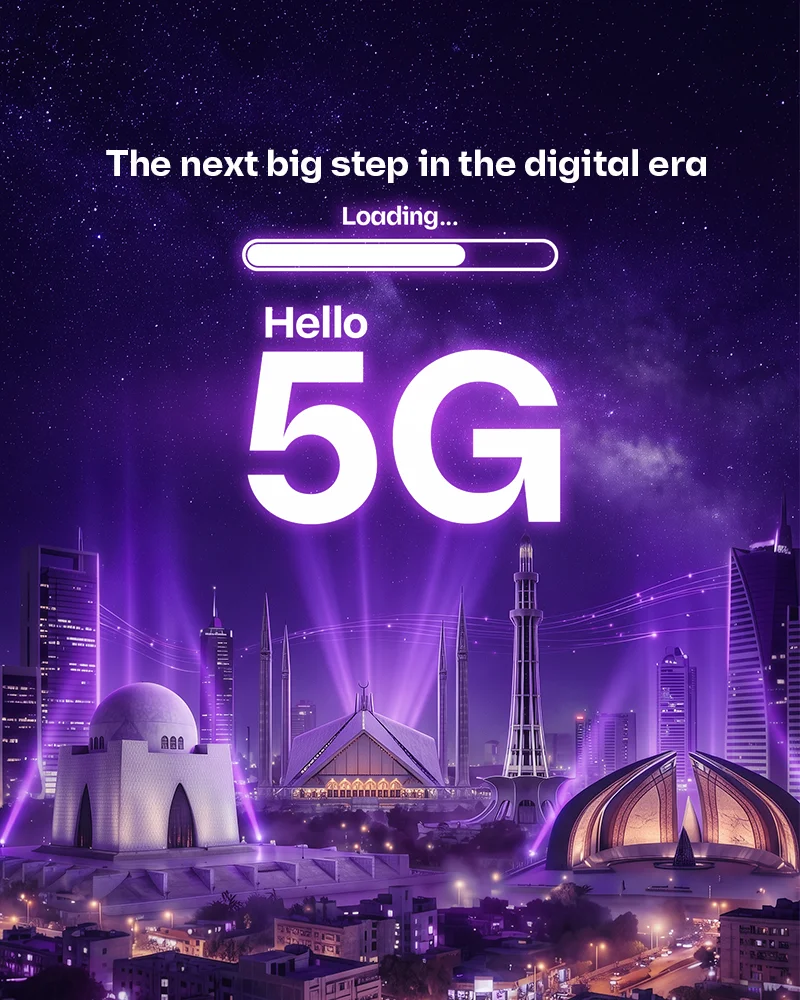
The future of mobile connectivity has officially arrived in Pakistan. As of March 2026, the Pakistan Telecommunication Authority (PTA) has formally granted 5G licenses to major operators like Jazz, Zong, and PTCL, marking the start of a phased rollout across major cities.
While 4G has been our reliable companion for years, 5G isn't just a minor speed boost; it’s a complete structural overhaul of the internet.
This guide breaks down the fundamental differences between 5G and 4G, explaining how the technology works and helping you decide if it’s finally time to upgrade your device to join the next generation of digital speeds.
What is 4G? A Quick Recap
Before we dive into the future, let’s look at our current workhorse. 4G reached Pakistan in 2014. It was designed for a world where people wanted to stream HD video and use social media on the go.
4G uses radio frequencies below 6 GHz to transmit data. While it revolutionized mobile broadband, it has a "capacity ceiling." Think of a 4G tower like a single Wi-Fi router in a large house.
If two people are using it, it’s fast. If 100 people join, everyone’s internet starts buffering. In crowded areas like a busy market in Lahore or a stadium in Karachi, 4G often slows down because it can only handle a few thousand devices per square kilometer.
This is why many users rely on flexible 4G monthly plans to maintain consistent performance for everyday usage, even in high-traffic areas.
What is 5G and How Does it Work?
5G is built on a new radio interface called 5G NR (New Radio) that is far more targeted and efficient than its predecessor.
Instead of broadcasting signals in wide, wasteful waves, 5G uses a technology called Massive MIMO and Beamforming to "aim" data directly at your device.
The Three Lanes of 5G
To deliver its massive performance, 5G operates across three different spectrum "lanes":
- Low-Band (Below 1 GHz): This is the foundation. It travels long distances and passes easily through the thick concrete walls of Pakistani homes. It provides the "wide net" of coverage but at speeds only slightly faster than 4G.
- Mid-Band (1 GHz – 6 GHz): The current "sweet spot" for Pakistan's 2026 rollout. It offers a perfect balance of high speed and reliable coverage. This is where you’ll see those 50–100 Mbps speeds in cities like Islamabad and Karachi.
- High-Band (mmWave / 24 GHz+): These ultra-high frequencies provide lightning speeds (up to 10 Gbps) but only over very short distances. These are being deployed in dense spots like airports, malls, and tech hubs.
5G vs 4G: The Three Key Pillars of Difference
Here is how they compare across the metrics that actually matter:
1. The Speed Gap
To put it simply: if 4G is a fast-moving car on a highway, 5G is a bullet train.
While 4G usually reaches speeds of around 100 Mbps in a perfect world, 5G is built to handle up to 10,000 or 20,000 Mbps (10–20 Gbps).
In Pakistan's initial 2026 rollout, the PTA has set a middle ground target of 50 Mbps for 5G users, which is already more than double the average 4G speed. By 2030, these speeds are expected to double again as the network infrastructure matures.
2. Latency (The "Lag" Factor)
Latency is the delay between clicking a link and the action happening.
- 4G Latency: Average of 30–50 milliseconds.
- 5G Latency: Can drop as low as 1–10 milliseconds.
This near-instant response makes 5G essential for things that require "live" feedback. For a gamer in Karachi playing, 5G could be the difference between winning a match and lagging out.
3. Massive Capacity (The "Crowd" Factor)
A 4G tower can support roughly 10,000 devices per square kilometer. A 5G network can support up to 1 million devices in that same space.
This is crucial for "Smart Cities." It means your internet won't come to a halt at a crowded concert or during a packed Friday prayer at a major mosque.
How Much Faster is 5G than 4G in Real Life?
In practical terms, the difference is staggering. Let's look at the "Movie Test." Imagine you want to download a full 2-hour High-Definition movie for a long flight:
- On 4G: You’ll be waiting about 7 to 10 minutes, just enough time to go make a cup of tea.
- On 5G: That same movie will be on your phone in under 10 seconds. It’s done before you can even put your phone in your pocket.
For content creators, 5G means you can upload a 4K vlog directly from the street in minutes rather than waiting hours for home Wi-Fi.
For freelancers, it means your video calls with international clients will be crystal clear, with no "robotic" voices or frozen screens.
Beyond Speed: The "Secret" Tech of 5G
Two technologies make 5G a "structural overhaul" rather than just a speed boost:
Network Slicing
This is a feature 4G simply does not have. Imagine a highway where you can suddenly create a "VIP lane" for ambulances that never gets congested, no matter how much traffic there is. 5G allows operators to create "virtual slices" of the network.
One slice can be dedicated to emergency services, another to high-end gaming, and another to basic web browsing. This ensures critical services never fail.
Small Cell Technology
Because high-frequency 5G signals don't travel far, operators are moving away from just giant towers. Instead, they are installing "Small Cells", boxes the size of a backpack, on lamp posts and buildings. This creates a much denser, more reliable "mesh" of internet across the city.
What are the Benefits of 5G over 4G?
The impact of 5G in Pakistan goes far beyond faster TikTok scrolls:
- Buffering-Free Everything: 8K video and 360-degree VR content stream instantly.
- The Internet of Things (IoT): 5G can connect your smart home, cameras, lights, and appliances—without slowing down your phone.
- Industrial Revolution (Industry 4.0): In industrial zones like Faisalabad and SITE Karachi, 5G enables real-time factory automation. Robots can coordinate seamlessly, increasing productivity for Pakistan’s exports.
- Precision Agriculture: For a country where agriculture is the backbone, 5G-connected sensors can monitor soil moisture and crop health in real-time, allowing drones to spray pesticides with pinpoint accuracy.
- Healthcare & Telemedicine: Specialists in major hospitals can guide complex procedures in remote areas of Balochistan or KPK using HD streaming and low-latency feedback.
Deep Dive: Infrastructure and Power Requirements
One of the biggest differences between 4G and 5G that people don't talk about is the energy and infrastructure required behind the scenes.
Why the Rollout Takes Time
Building a 4G network was about building towers. Building a 5G network is about laying thousands of kilometers of fiber-optic cable. Because 5G speeds are so high, the data can't travel through traditional wires between towers.
Everything must be connected via fiber. In Pakistan, the challenge is digging up roads and laying this fiber in congested cities like Rawalpindi or Lahore.
Power Management
On the tower side, 5G equipment requires more electricity to run the Massive MIMO antennas. On the phone side, your device's processor has to work much harder to decode the high-frequency signals.
This is why 5G phones often need better cooling systems and larger batteries than their 4G predecessors.
Are There Any Downsides to Using 5G?
As powerful as it is, 5G has a few early-stage hurdles:
- Battery Drain: 5G modems are power-hungry. If your phone is constantly searching for a 5G signal in an area with poor coverage, your battery will drop faster.
- Coverage Gaps: High-speed 5G signals are easily blocked by walls and trees. You might have 5G outside on the street, but it could drop to 4G once you step deep inside a concrete building.
- The Hardware Cost: 5G-ready phones and data plans typically carry a 10–20% premium over standard 4G options.
Do You Need a New Phone for 5G?
Yes. You cannot "software update" a 4G phone into a 5G one. It requires a specific modem and specialized antennas built into the hardware at the factory. As of 2026, many affordable 5G smartphones are now hitting the Pakistani market.
Brands like Xiaomi, Realme, and Infinix are launching 5G-ready devices, making the technology accessible to more than just the "flagship" crowd. If you are buying a used phone, look for the "5G" branding or check the processor specs.
The Economic Impact: Why 5G Matters for Pakistan
The PTA isn't just launching 5G for faster social media; it's a move to boost the national economy.
- Freelance Economy: Pakistan is one of the world's largest hubs for freelancers. High-speed, low-latency internet allows Pakistani developers and designers to work on heavy cloud-based software as if they were sitting in Silicon Valley.
- E-commerce: 5G allows for Augmented Reality (AR) shopping. Imagine seeing how a new sofa looks in your Karachi apartment through your phone screen before buying it. This will boost the digital economy significantly.
- Logistics: Smart tracking of trucks and shipments across the country becomes possible, reducing fuel waste and delivery times.
Is 5G Available in Pakistan and is it Worth it?
The 2026 Status: 5G is currently going live in major hubs like Karachi, Lahore, Islamabad, and Faisalabad.
- For the Casual User: If you mainly use WhatsApp and browse Facebook, 4G is still a reliable, battery-efficient choice. You might not notice a massive difference.
- For the Power User: If you are a gamer, content creator, or remote professional, the jump to 5G is a total game-changer. It eliminates the "friction" of the internet.
Final Thoughts: The Road to 2030
5G is not just a luxury; it is the backbone of Pakistan's digital future. While 4G will remain the primary network for many rural areas for years to come, 5G is setting the stage for a smarter, more connected nation.
Everything is smoother, faster, and built to handle the heavy traffic of our modern digital lives. Switching to 5G in 2026 is like moving from a congested, bumpy dirt road onto a wide-open, 10-lane motorway.
Frequently Asked Questions About 5G and 4G in Pakistan
1. Is 5G faster than 4G in real life?
Yes. While you won't always hit the 10 Gbps peak in daily use, real-world tests in Pakistan show 5G is consistently 10x to 20x faster than the average 4G connection in high-traffic urban areas.
2. Can I use 5G with my current SIM card?
Most modern 4G SIMs in Pakistan support 5G, provided your phone and area are compatible. To get the best performance, you might need to visit a franchise for a quick upgrade to a "5G-Ready" USIM. For the most seamless experience in 2026, switching to an eSIM is the best way to unlock 5G speeds instantly.
3. Does 5G drain the battery faster than 4G?
Yes, particularly in areas where the signal is still being optimized. However, most modern phones have a "Smart 5G" setting that only uses 5G when needed for high-speed tasks to preserve battery life.
4. Is 5G safe to use?
Yes. According to the World Health Organization (WHO) and the PTA, 5G uses non-ionizing radio waves that fall well within international safety guidelines, the same type of waves used for Wi-Fi and 4G for decades.
5. When will 5G be available everywhere in Pakistan?
Expect major cities to have robust coverage by the end of 2026. Smaller towns and rural areas will follow a gradual rollout through 2028 and beyond, as infrastructure is expanded.
Table of Contents



© 2026 Onic - a Digital Brand of Pak Telecom Mobile Limited. All Rights Reserved